Digital marketing continues to evolve at an extraordinary pace. New technologies, changing consumer behavior, and evolving search ecosystems are constantly reshaping how businesses connect with their audiences.
For companies that want to remain competitive, understanding emerging trends is essential. The strategies that worked a few years ago may no longer be enough in today’s digital landscape.
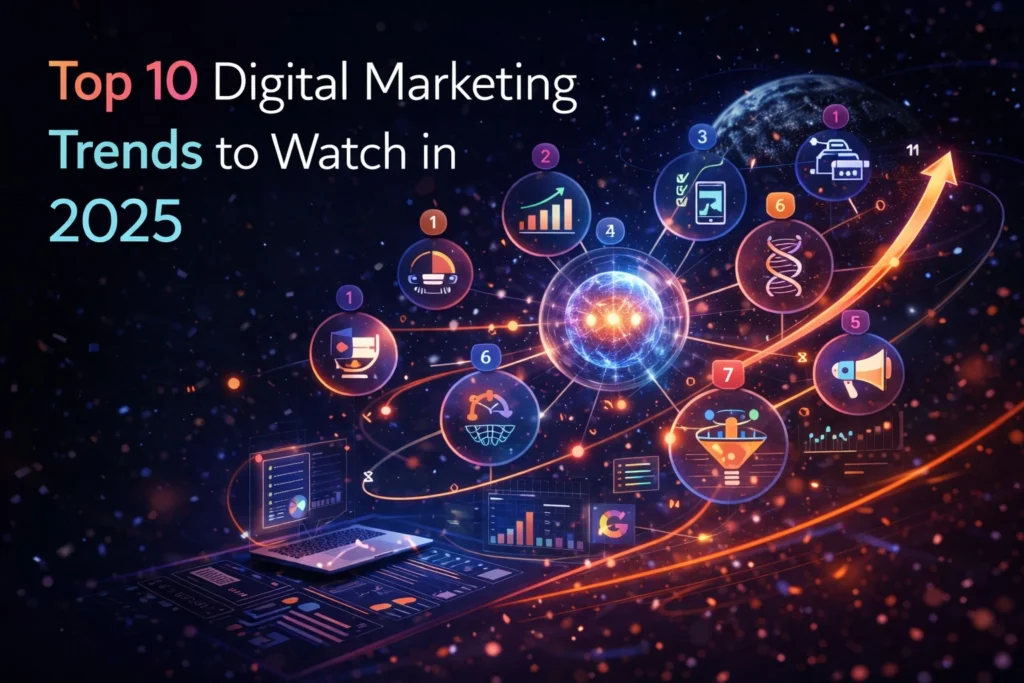
In this article, we explore the top digital marketing trends shaping the industry in 2025—from AI-driven personalization and new search experiences to video content and data-driven decision making.
Staying ahead of these trends can help businesses build stronger relationships with customers, improve performance, and unlock new growth opportunities.
Artificial intelligence is rapidly transforming digital marketing. AI-powered tools are now used to analyze customer behavior, automate campaigns, and generate insights that were previously difficult to uncover.
Businesses are increasingly using AI for:
Predictive analytics
Marketing automation
Personalized recommendations
Content generation
Campaign optimization
AI allows marketers to work more efficiently while delivering more personalized customer experiences.
Consumers expect brands to understand their preferences and deliver tailored experiences. In 2025, personalization is becoming more sophisticated thanks to advanced data analytics and machine learning.
Brands can now personalize:
Website content
Product recommendations
Email campaigns
Advertising experiences
This level of personalization improves engagement and significantly increases conversion rates.
Voice assistants and smart devices are changing how people search for information online. Voice queries tend to be longer and more conversational than traditional searches.
Businesses should optimize their content for voice search by:
Targeting conversational keywords
Answering common customer questions
Structuring content clearly for featured snippets
Voice search will continue to influence SEO strategies in the coming years.
Video content has become one of the most powerful tools in digital marketing. Platforms like YouTube, TikTok, and Instagram have transformed how brands communicate with audiences.
Short-form videos, product demonstrations, and educational content are especially effective at capturing attention and building trust.
Businesses investing in video marketing often see higher engagement and stronger brand recognition.
Data is becoming the foundation of modern marketing strategies. Companies are increasingly relying on analytics and customer insights to guide decisions.
Data-driven marketing enables businesses to:
Understand customer behavior
Optimize campaign performance
Improve targeting and segmentation
Measure return on investment
Organizations that effectively leverage data gain a significant competitive advantage.
With stricter privacy regulations and the gradual decline of third-party cookies, businesses must rely more heavily on first-party data.
This includes information collected directly from customers through:
Website interactions
Email subscriptions
CRM systems
Customer purchases
First-party data helps brands maintain strong personalization while respecting user privacy.
Search behavior is evolving. Users now discover brands through multiple platforms including social media, video platforms, and AI-powered search experiences.
Modern SEO strategies must consider:
Social search
Visual search
AI-generated search results
Multi-platform discoverability
Businesses that optimize across these channels can increase visibility and reach new audiences.
Interactive content is becoming increasingly popular because it encourages user engagement and participation.
Examples include:
Interactive quizzes
Calculators and tools
Live polls
Personalized assessments
Interactive experiences create stronger connections between brands and their audiences.
As marketing ecosystems grow more complex, automation is helping businesses manage campaigns more effectively.
Automation tools allow companies to:
Schedule campaigns
Trigger personalized communications
Manage customer journeys
Analyze marketing performance
This improves efficiency while maintaining consistency across channels.
Search engines and users increasingly prioritize websites that provide seamless digital experiences.
High-performing websites focus on:
Fast loading speeds
Mobile optimization
Clear navigation
Intuitive design
A well-designed user experience not only improves rankings but also significantly increases conversion rates.
The digital marketing landscape in 2025 is shaped by innovation, data, and evolving customer expectations. Businesses that embrace emerging technologies and adapt their strategies will be better positioned to compete in an increasingly dynamic environment.
By focusing on AI-driven marketing, personalization, strong content strategies, and high-performing digital experiences, companies can stay ahead of the curve and build sustainable growth.
Understanding these trends today allows businesses to prepare for the opportunities of tomorrow.