
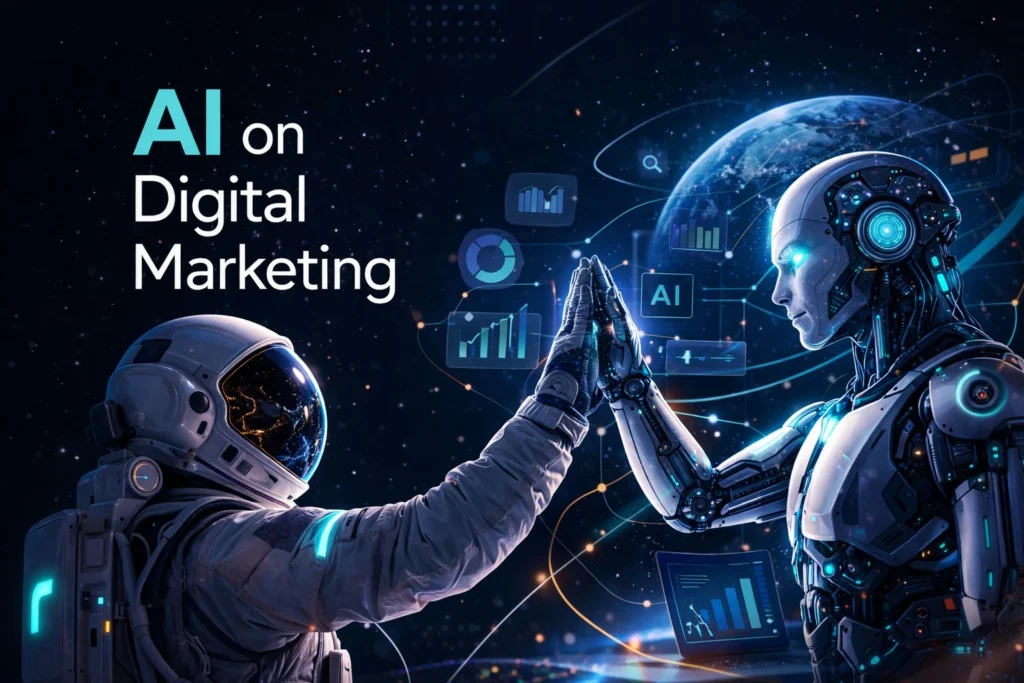
Artificial Intelligence is rapidly reshaping the digital marketing landscape. What was once considered an emerging technology has now become a fundamental component of modern marketing strategies. Businesses today are expected to deliver personalized experiences, make data-driven decisions, and adapt quickly to changing consumer behavior — all at scale.
AI enables marketers to process large volumes of data, automate complex tasks, and gain deeper insights into customer behavior. As competition increases and digital ecosystems become more complex, organizations that successfully integrate AI into their marketing operations gain a significant advantage in efficiency, targeting, and overall performance.
Understanding how AI influences digital marketing is essential for companies that want to remain competitive in the coming years.
Digital marketing generates an enormous amount of data — from website interactions and social engagement to ad performance and customer journeys. Without advanced tools, extracting meaningful insights from this data can be challenging.
Artificial intelligence helps transform raw data into actionable insights. Machine learning algorithms can analyze patterns in user behavior, identify trends, and predict future outcomes with remarkable accuracy.
This capability allows businesses to:
Identify high-value audiences
Understand customer intent and behavior
Optimize marketing strategies in real time
Forecast campaign performance
Instead of relying solely on manual analysis, marketers can use AI-powered tools to make faster and more informed decisions.
Modern consumers expect personalized experiences when interacting with brands online. Generic marketing messages are becoming less effective as users increasingly demand relevant and tailored content.
AI makes personalization scalable by analyzing customer data and automatically adapting content, product recommendations, and messaging based on user behavior.
Examples of AI-driven personalization include:
Dynamic website content tailored to individual visitors
Personalized product recommendations in e-commerce
Customized email marketing campaigns
Targeted advertising based on behavioral signals
These personalized interactions significantly improve engagement, customer satisfaction, and conversion rates.
Digital advertising platforms already rely heavily on artificial intelligence. Platforms such as Google Ads and Meta Ads use machine learning to optimize campaigns continuously.
AI-driven advertising systems can automatically:
Adjust bids in real time
Identify high-performing audiences
Allocate budget efficiently across campaigns
Test multiple ad variations simultaneously
This level of automation helps marketers achieve better results while reducing the time spent managing campaigns manually.
The result is improved return on investment and more efficient marketing budgets.
AI-powered tools are also transforming how content is created and optimized. From generating ideas to analyzing search trends, artificial intelligence helps marketers produce content that aligns with audience interests and search intent.
AI can assist with:
Content ideation and topic discovery
Keyword research and SEO optimization
Content performance analysis
Automated content recommendations
However, while AI tools can accelerate the production process, human expertise remains essential to ensure originality, strategic alignment, and brand authenticity.
The most effective approach combines AI efficiency with human creativity and strategic thinking.
One of the most powerful advantages of AI is predictive analytics. By analyzing historical data and behavioral signals, AI systems can anticipate future actions and customer needs.
Predictive marketing allows businesses to:
Identify customers likely to convert
Detect churn risks early
Anticipate purchasing behavior
Deliver targeted campaigns at the right moment
This proactive approach helps businesses engage customers more effectively and strengthen long-term relationships.
Search behavior is also evolving rapidly with the integration of AI technologies. Search engines increasingly rely on machine learning models to understand user intent, context, and content quality.
In addition, new forms of discovery are emerging, including:
AI-powered search assistants
Voice search
Visual search
Generative AI search experiences
These developments are changing how users find information online, requiring businesses to rethink their SEO and content strategies.
Companies must now optimize not only for traditional search engines but also for AI-driven discovery platforms.
Despite its capabilities, AI is not a replacement for marketers. Instead, it acts as a powerful tool that enhances human expertise.
Strategic thinking, creativity, brand storytelling, and ethical decision-making remain essential components of effective marketing. AI provides insights and automation, but the human perspective ensures that strategies remain aligned with business goals and customer expectations.
The most successful organizations treat AI as a collaborative partner rather than a complete solution.
As artificial intelligence continues to evolve, its influence on digital marketing will only grow stronger. Businesses that embrace AI technologies early will benefit from increased efficiency, deeper insights, and stronger customer engagement.
However, implementing AI effectively requires more than simply adopting new tools. It requires a clear strategy, strong data infrastructure, and an understanding of how AI integrates with existing marketing operations.
Companies that invest in AI capabilities today will be better positioned to navigate the rapidly changing digital landscape.
Artificial intelligence is no longer optional in digital marketing — it is becoming a core component of modern strategies. From predictive analytics and personalized experiences to automated campaign optimization, AI is redefining how businesses connect with their audiences.
Organizations that successfully integrate AI into their marketing strategies will gain a competitive advantage through smarter decisions, more efficient operations, and more meaningful customer interactions.
As the digital ecosystem continues to evolve, combining human creativity with AI-powered intelligence will define the next generation of successful marketing strategies.